Monday, July 7, 2014

Welcome!

New HAA Instructors

We're pleased to announce the addition of three very fine musicians and individuals to the HAA teaching staff: Colt Ballou, Katie Morris, and David Pratt. Please help us welcome them!

Colt Ballou


Colt Ballou teaches voice, piano, organ, Children's Music Academy, Kindermusik, and vocal ensembles. He is currently attending the University of Nebraska-Lincoln where he is pursuing a Master's degree in Choral Conducting, as well as studying organ. Colt was active as a vocal music teacher in Iowa before relocating to Lincoln, NE.

More About Colt >>

Hobbies: Travel, fitness and exercise, cooking, reading
Favorite Foods: Sushi, pistachio ice cream
A Book Everyone Should Read: Oh, the Places You'll Go! by Dr. Seuss
Favorite Quote: "The teacher who is indeed wise does not bid you to enter the house of his wisdom but rather leads you to the threshold of your mind." ~Khalil Gibran
Favorite Joke: 
Q: How can you tell when a singer is at your door?
A: They forgot the key and don't know when to come in!

Katie Morris


Katie Morris teaches voice, piano, flute, Kindermusik, and Children's Music Academy. She graduated from Doane College and taught K-12 vocal music for Planview Public Schools before moving to Lincoln, NE. She was just married at the end of June - congratulations!

More About Katie>>

Hometown: Utica, Nebraska
Hobbies: Running, reading, and spending time with the love of my life!
Favorite Foods: Peanut butter and mashed potatoes...not together though!
Favorite Book: To Kill a Mockingbird and the whole Harry Potter series
Little Known Fact About Me: I played French horn in fifth grade for two days before switching to flute for good.

David Pratt


David Pratt teaches violin and electric violin. A fan of the Suzuki Method, he enjoys using the repertoire to teach in an intuitive manner with a natural progression. Originally from San Diego, David also grew up in the Washington, D.C. area, before moving to Lincoln, NE.  David will attend the University of Nebraska-Lincoln as a chemistry major in hopes of attending medical school.

More About David >>

Hometown: San Diego, CA, and Washington, D.C.
Hobbies: I am learning Spanish using Rosetta Stone and have found the program useful. I enjoy mountain biking but haven't found many mountains in Nebraska.
Favorite Food: Mexican and Sushi
Favorite Piece of Music to Play: Praeludium and Allegro by Fritz Kreisler
A Book Everyone Should Read: The Black Swan: The Impact of the Highly Improbable
Favorite Quote: "The number one reason why people give up so fast is because they tend to look at how far they still have to go, instead of how far they have gone." ~unknown

Tuesday, July 1, 2014

Instructor Spotlight

Cristina Vlad


Cristina Vlad, a piano instructor at Harris Academy of the Arts, has been playing the piano since she was very young. She started playing for fun but after more and more performances and competition wins, she began to realize she really loved playing. Now, years later and having just completed her doctorate in piano performance at the University of Nebraska-Lincoln, we are privileged to have her on the Harris team!

Cristina was born in Romania in a town named Deva. You might be more familiar with the region, called Transylvania, the home of Count Dracula. But don’t worry, Cristina’s bubbly, friendly personality has nothing in common with that character. And though you wouldn't need to, you can always score points by offering her one of her favorite desserts: cheesecake and ice cream!

More about Cristina:

What is your favorite kind of music?
Besides classical, I enjoy a wide variety of genres. I am really fond of Jazz, among others.

What other hobbies do you have besides music?
I love dancing and soon will go get some tango lessons. J

What do you think is the best movie of all time?
I don’t have a “best movie of all time” but rather a list…Forrest Gump is on that list J, among others.

Do you have any good stories about where you grew up?
Of course, you can find out more by asking. Let’s just say for now that my last name (Vlad) is the same as Count Dracula’s, and that I am from the same area (Transylvania).

Do you have a fun or inspiring story to share about teaching lessons?
Everyone has different goals when taking on music/piano lessons. It’s always great hearing back after years from students, thanking you for the change you brought to their life through lessons.

What is one of your favorite recital or performance memories?
Sharing your love for music with an audience is something unique. After a broadcast performance of mine, the camera showed the reaction of the audience. It was very touching seeing someone tearing at the end.

What is your favorite quote?
“If you wish to succeed in life, make perseverance your bosom friend, experience your wise counselor, caution your elder brother, and hope your guardian genius.” – Joseph Addison

View Cristina's Bio

Thursday, June 26, 2014

Fiddlin' Fools!

Harris Academy of the Art's Beginning Fiddling Summer Workshop wrapped up today after a full month of exploring fiddling technique and repertoire.


We spent a little time with instructor, Jentry Barrett, to learn more about fiddling and what her students have been learning. No fiddling around, this sounds like fun!

What’s the difference between a violin and a fiddle?
"A violin and fiddle are the same thing. Fiddling is just a style of violin playing. There is an old joke that fiddling is just violin playing with bad posture, but not in my class!"

What skills does a student need to have before they can start fiddling?
"If you can play the violin successfully then you can play fiddle tunes. You need to be able to consistently play in tune, cross strings without excess noise, and have a relaxed posture so playing fast notes is easy."

What is your favorite fiddle tune?
"I love Cripple Creek. Lots of fast notes, but not a lot of different notes, so it looks harder than it really is!"

What else can you tell us about fiddling?
"There are lots of different styles of fiddling, and so much music to enjoy. That is the gift of playing the violin well, you get to play so much fun music."

The Final Class Performance 


Mark Your Calendars:

World Fiddle Day is May 17, 2015
Look for more
FIDDLE CLASS OFFERINGS from Harris beginning Fall 2014!


More Photos:


Monday, August 26, 2013

Tips for the Vocalist


Whether you've been singing for years or have only just started taking vocal lessons, it is important to remember to do things properly. Much like exercise, singing should be done gradually and in moderation. You wouldn't go to the gym for five hours once a week and expect the same results as you get going once a day for 30 - 45 minutes, would you? 

Singing is exactly the same. Singing too loud or for too long can cause damage that could potentially lead to more serious issues later down the road. 

So here are some simple tips to make you a better vocalist than you already are!

1. Train your voice like an athlete trains for a sport. Practice in moderation, and don’t push yourself too hard -- you’ll negate any positive results by pushing too hard! Also as an athlete would, be sure to warm up before a performance/practice and cool down after. Warming up helps stretch your vocal chords and prepare them, and cooling down helps to not strain them with a sudden halt in singing.

2. Be YOU. If you try to copy a voice you like on the radio, not only could that lead to damage (your voice might not be able to physiologically handle their range, tone, etc. even if it feels comfortable!) but the radio stars are already making money for their voice -- let YOUR voice ring out!

3. Pace yourself. If you practice correctly and in a good moderation, you’ll notice your skills and duration enhance over time. This is the correct way -- NOTHING that takes hard work can miraculously happen over night. Everything takes time, practice, and moderation.

4. Avoid stress and trauma on your vocal chords. Try not to scream, yell, or strain your vocal chords on a regular basis. And yes, Husker fan vocalists, that means you too!

5. Hydration, hydration, hydration! Drink enough water. This is an important every-day habit to have, but it will also help your vocal chords out and they won’t get “dry” as fast when you’re in the middle of a performance!

And as a side note with the hydration tip -- from personal experience, I've found I perform long programs better when I have a bottle of water off to the side that I can take a sip from in between songs or during long breaks in the music. Contrary to some beliefs, this doesn't look unprofessional -- quite the opposite, it shows you take your talent seriously. Athletes drink water constantly throughout big games, pop stars go through water bottles extremely fast on stage -- so YOU as a vocalist can drink water throughout your performance as well!


Thursday, August 22, 2013

Piano Exercises

If you’re a pianist then you know the importance of regular practice and finger “exercise” on the instrument. Here are some tips to help strengthen fingers and dexterity with the piano, some of which can be worked on even without the instrument itself.

1. Play some scales.
It’s true, scales can be an irritating repetition for musicians, but they along with arpeggios really work! Not only do they help reinforce knowledge of notes and key signatures, but they aid in finger strength and rhythm. Try playing scales in a variety of ways: legato, staccato, regular rhythm, etc.

2. Finger stretches.
Play two notes at least an octave apart with thumb and finger, and play a third note somewhere in between with a finger of your choice. (using your 4th finger might be a good choice, as it’s one of the weaker fingers to begin with) Also try holding your thumb down on one note and play ascending staccato notes as far up as possible with another one of your fingers to stretch them.

3. Work your weaker hand, too.
Practice parts that are usually played by your dominant hand with your “weaker” hand to familiarize that hand with melodic lines and new exercises.

4. Work your weaker fingers.
For most pianists and piano students, the fifth finger (pinky) is weaker than the other fingers. Try practicing scales and keeping the volume even across all fingers, which might require a bit of an extra push with the fourth and fifth fingers. Doing this will help strengthen your weaker fingers.

5. Tempo changes.
Try playing pieces that you know very well (or even have memorized) at different speeds. Start off as slow as possible, and work your way to a tempo faster than what you normally play at.

Wednesday, August 21, 2013

How to Write a Song

Songwriting is a skill that is easily obtainable by anyone wanting to learn. Writing a song has one very basic point: write down everything you think about.

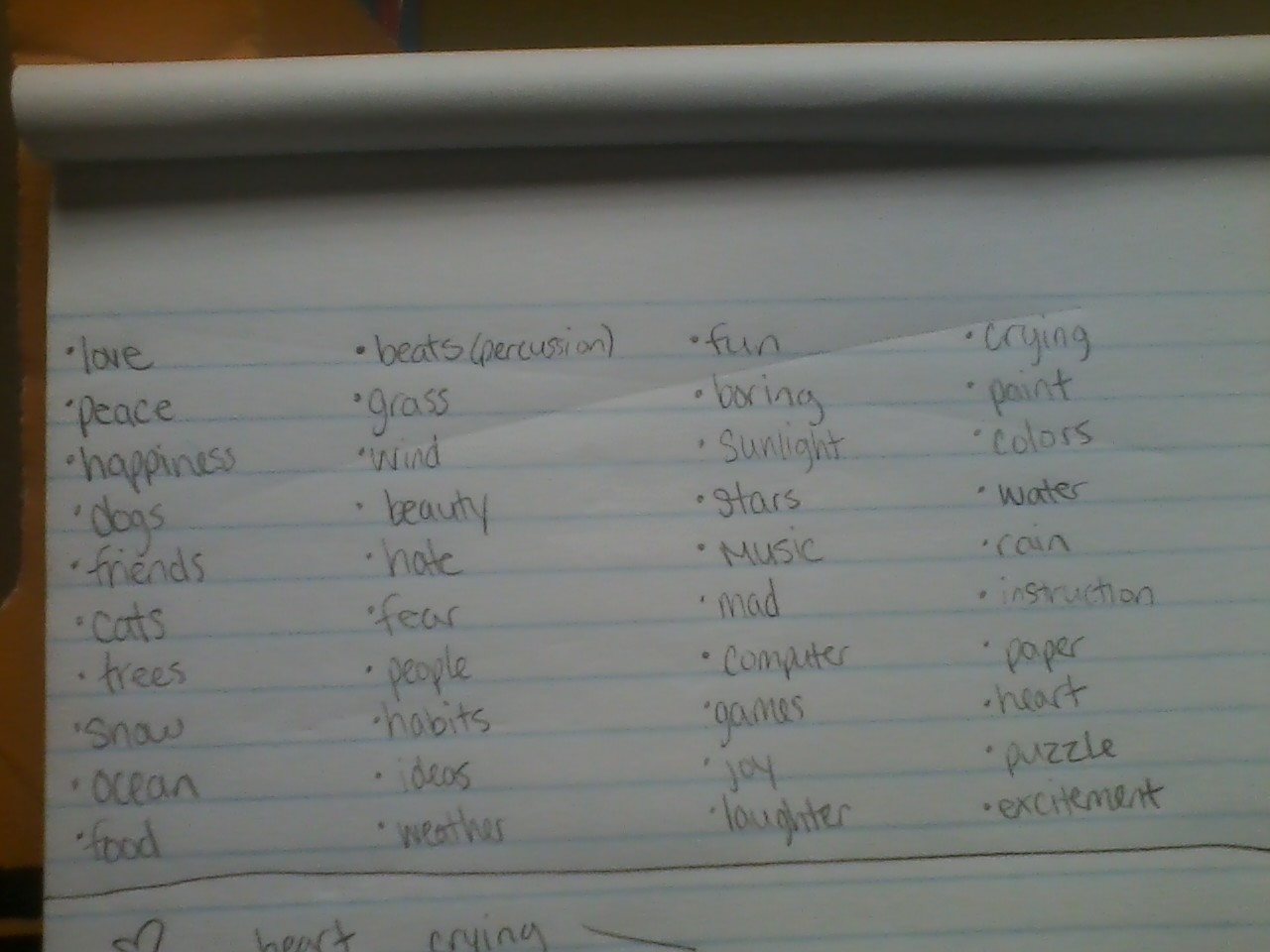
Back when I was in high school and writing a lot, especially for speech competitions, I had a coach once tell me “I want you to vomit words onto the page.” I gave her a disgusted look, until she explained what she meant. She wanted me to write down everything I thought of -- every word, phrase, sentence, sight, smell, etc.

Granted, that was for writing informative and entertainment speeches. But the same technique can easily be applied to songwriting!

Your list can be organized and complete, like this:


Or it might end up being a bit all over the page, like this:


The thing to remember is you have to just do whatever works best for YOU. Do you like organization and making lists? Then the list option of “word vomit” will probably be beneficial. If you don’t care for organization or would rather the activity seem less like homework, then drawing and doodling words all over the page might be more helpful. Again, just do whatever works best for you. If you have a different way than these two methods, that’s great, too!

The next step is picking out your favorites. And the best part about songwriting and coming up with lyrics?

It’s absolutely 100% subjective.

This means that it doesn't have to make any sort of sense to anyone but you. And even then, that’s completely up to you! If you want to write a chorus to a song that’s something like:

Computers, games, that’s my jam.
Come on snowman, see me as I am.
Love my friends and going to the park.
My cat’s name is Chopin, and he loves to bark!

THEN GO FOR IT! Songwriting is so subjective, regardless of what “professionals” might think. If you write something and put music behind it, it’s your song. (Also, it doesn't have to rhyme at all, that’s just one of my personal songwriting habits.)

Songwriting, when looked at in its most basic form, is an extremely simple skill. Anyone can do it. So pick up a pencil (or pen, marker, crayon, etc.) and some paper, and get down to it! And if you’d like, let us know what you or your child writes by sharing in the comments section. Though anything inappropriate will be deleted! Songwriting may be subjective, but this is still a public blog and we’d like to keep things age friendly around here. :)

Tuesday, August 20, 2013

Boost Your Mood

Music has been proven to boost moods for quite some time now. And everyone knows the happier you are, the healthier you are! Whether you’re playing or listening, music is a wonderful tool to help boost happiness and diminish stress.

The key to music making you happier is very simple: do what makes you happy. Does simply sitting back and enjoying an album or a few music videos boost your mood? Then do that. Does playing a musical instrument and learning the technique help to put a smile on your face? Then learn! It’s a simple concept -- you have to do what makes you happy.

If you aren't completely satisfied in what you are doing, it will feel like a chore and you’ll no longer look forward to it. This will lead to stress, and stress can lead to a lot of negative feelings.

If you’re playing an instrument and feel like it’s forced, try something new! Whether it’s a new technique on your current instrument or a new instrument altogether, trying something new will make everything feel like a brand new adventure and help boost your happiness level and lower the stress.

At Harris Academy of the Arts, a wide variety of music lessons and classes are available. They are taught by university trained instructors, and students leave with a smile on their face daily.

Doing what makes you happy is one of the bigger goals you should have for yourself further down the road. At Harris, we’re here to help enhance one of those mood-boosters!

It is important to always remember: be happy, stay healthy. If what you’re doing now feels like it’s weighing you down, maybe it’s time for a fresh start. Find something new to spice up your current instrument of choice, or pick a new one and give it a shot. Even if it’s just for fun and you later return to your first instrument! Just anything to remind you why you’re doing this in the first place...

Because it makes you happy.